
AI Testing Is Not AI Assurance: Why the Difference Matters
As artificial intelligence becomes embedded in more business processes, organisations are investing heavily in testing. They test whether an AI assistant answers correctly, whether a model follows instructions and whether expected outcomes are produced before deployment.
That work is necessary. But it is not the same as AI assurance.
Testing asks whether an AI system performed as expected under a defined set of conditions. Assurance asks a broader and more persistent question:
Can the organisation demonstrate, with objective evidence, that the AI system continues to behave within acceptable quality, risk and compliance thresholds?
The distinction matters because AI does not behave like conventional software. Its outputs can vary, its surrounding systems can change and its behaviour may shift over time. A successful test today does not automatically provide confidence in how the system will perform tomorrow.
Why traditional testing is not enough
Traditional software is largely deterministic. When the same input is processed under the same conditions, teams generally expect the same output. This makes it possible to define a result, run a test and mark it as passed or failed.
AI systems are different. They are probabilistic, which means the same question can produce different responses. Some differences may be harmless. Others may affect accuracy, fairness, customer outcomes, policy compliance or risk.
An AI system can also change even when the underlying model has not been intentionally replaced. Its behaviour may be influenced by:
- Changes to prompts, instructions or system configuration
- Updates to connected models, data sources or external services
- Changes in retrieval content or knowledge bases
- New user behaviour and unexpected input combinations
- Model updates introduced by a third-party provider
- Adjustments to guardrails, policies or business rules
A point-in-time test provides a snapshot. It can show what happened during a specific evaluation, but it cannot by itself demonstrate that the system remains reliable over time.
What AI assurance adds
AI assurance builds on testing by creating an ongoing body of evidence around the system’s behaviour, controls and performance.
It is not simply about running more test cases. It is about establishing a structured and traceable way to answer questions such as:
- What was tested, when and against which version of the system?
- What quality, risk and compliance thresholds were applied?
- How consistent were the responses across repeated evaluations?
- What changed between one evaluation and the next?
- Were unexpected behaviours identified, investigated and addressed?
- Who reviewed or approved the results?
- Is there an auditable record supporting the organisation’s conclusions?
This turns AI evaluation from a collection of test results into a defensible assurance process.
From “Did it pass?” to “Can we demonstrate control?”
For conventional software, a pass or fail result may be sufficient for many tests. For AI, the better question is often whether the system is performing within an acceptable range.
An organisation may need to measure:
- Accuracy and relevance
- Response consistency and variability
- Policy and regulatory alignment
- Harmful, misleading or inappropriate outputs
- Refusal behaviour and guardrail effectiveness
- Changes in performance between models or versions
- Whether defined risk limits or failure thresholds have been exceeded
This requires teams to define what acceptable behaviour means before they can determine whether the AI remains within it.
Without defined thresholds, a team may detect that something changed but struggle to decide whether the change is material. Without traceability, it may be unable to explain when the change happened or what caused it. Without an evidence history, it may be difficult to demonstrate that appropriate steps were taken.
AI assurance connects these elements: evaluation, thresholds, monitoring, investigation and evidence.
Why evidence matters in regulated organisations
As AI becomes involved in customer service, financial decisions, operations and other important processes, organisations may be expected to do more than say that a system was tested.
They may need to demonstrate that they took reasonable steps to understand, evaluate and monitor its behaviour.
That means being able to produce evidence showing:
- How the system was evaluated before and after deployment
- Which risks and expected behaviours were considered
- How performance changed over time
- What controls and acceptance thresholds were applied
- How issues were identified, escalated and resolved
- Who was accountable for reviewing and approving the system
This evidence supports more than regulatory readiness. It also helps technology, risk, compliance, audit and business teams work from the same objective record.
When evidence is fragmented across spreadsheets, testing tools, emails and individual teams, it becomes difficult to build a clear picture of the AI system’s history. A centralised assurance record makes that history easier to review, compare and defend.
Independent assurance creates stronger confidence
The teams that build and deploy an AI system should test it extensively. However, internal testing and vendor claims may not provide the level of independence required for higher-risk use cases.
Independent AI assurance introduces an additional layer of scrutiny. It evaluates the system against defined requirements and thresholds while maintaining objective evidence of the results.
This does not replace the work of development, security, risk or compliance teams. It strengthens their work by providing a consistent way to verify claims, measure behaviour and demonstrate how conclusions were reached.
Independence becomes particularly valuable when an organisation needs to answer difficult questions about an AI system:
- Are we relying mainly on evidence supplied by the organisation that built it?
- Have we tested beyond expected and ideal user behaviour?
- Can we reproduce and explain the results?
- Can we show that the system was assessed consistently across versions?
- Do we have objective evidence that it remains within approved limits?
The goal is not to create another approval step. It is to create confidence that is supported by evidence rather than assumption.
AI assurance is a continuous discipline
Assurance should not end when an AI system is released.
Models change. Data changes. prompts change. Connected services change. Customer behaviour changes. An AI system that performed acceptably during deployment testing may behave differently after weeks or months in production.
A continuous assurance approach allows organisations to:
- Define expected behaviours, policies and acceptable thresholds.
- Evaluate the system repeatedly across realistic and high-risk scenarios.
- Measure variability rather than relying on a single response.
- Compare performance across versions, models and time periods.
- Detect unexpected changes before they become larger issues.
- Record findings, decisions, actions and approvals.
- Maintain a traceable history for internal and external review.
This creates a feedback loop between evaluation and governance. Testing generates results. Assurance turns those results into evidence, accountability and ongoing oversight.
Moving beyond “trust us”
As AI adoption grows, confidence cannot rely solely on a vendor saying its system is safe, or on a team confirming that testing was completed.
Organisations will increasingly need to show how they reached that conclusion.
The question is shifting from:
“Did we test the AI?”
to:
“Can we demonstrate that we took reasonable steps to understand, evaluate and monitor its behaviour?”
That is the difference between testing and assurance.
Testing remains essential, but assurance provides the broader framework needed to manage AI as a continuing business, operational and governance risk. It creates the evidence that allows organisations to understand what changed, determine whether the AI remains within acceptable limits and demonstrate that appropriate controls have been applied.
How Hoot supports independent AI assurance
Hoot enables organisations to continuously evaluate AI systems and maintain traceable evidence of their behaviour over time.
By measuring variability, applying defined quality and risk thresholds, comparing performance across evaluations and maintaining a history of results and changes, Hoot helps teams move beyond point-in-time testing toward a more structured assurance approach.
For technology, risk, compliance and audit teams, this creates an independent system of record showing how AI has been evaluated, how its performance has changed and whether it continues to operate within acceptable parameters.
Want to see how independent AI assurance works in practice?
Book a meeting with Hoot to explore how continuous evaluation, traceability and objective evidence can strengthen your organisation’s approach to AI risk.
Latest Blogs
The latest news, strategies, and insights from Hoot.
Your AI Vendor Made the Mistake. The SRA Says You May Still Be Responsible.
Law firms are rapidly adopting AI. From legal research and document review to drafting, case management and client-facin...
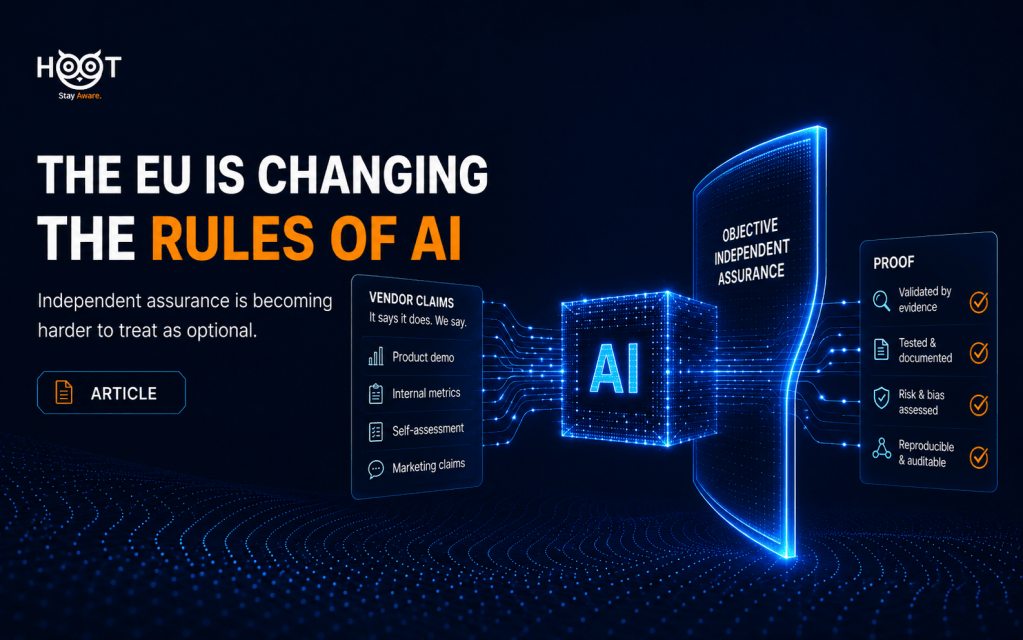
The EU Is Changing the Rules of AI. Independent Assurance Is Becoming Hard to Treat as Optional.
For the past few years, many organisations have approached AI governance largely as a matter of trust.

AI Platform Vendors Build AI. They Don’t Independently Assure It
One of the biggest misconceptions in enterprise AI is that the organisation building the AI should also be responsible f...
What AI Insurance Reveals About the Future of AI Risk
When one of the world’s largest insurance groups launches dedicated AI liability insurance, it sends a powerful me...
What Are You Actually Testing in Your AI?
Most Businesses Test the Chatbot. Very Few Test the Experience.

Your AI Customer-Facing Chatbot
From banking and insurance to healthcare, utilities, and e-commerce, AI chatbots are quickly becoming the first line of ...