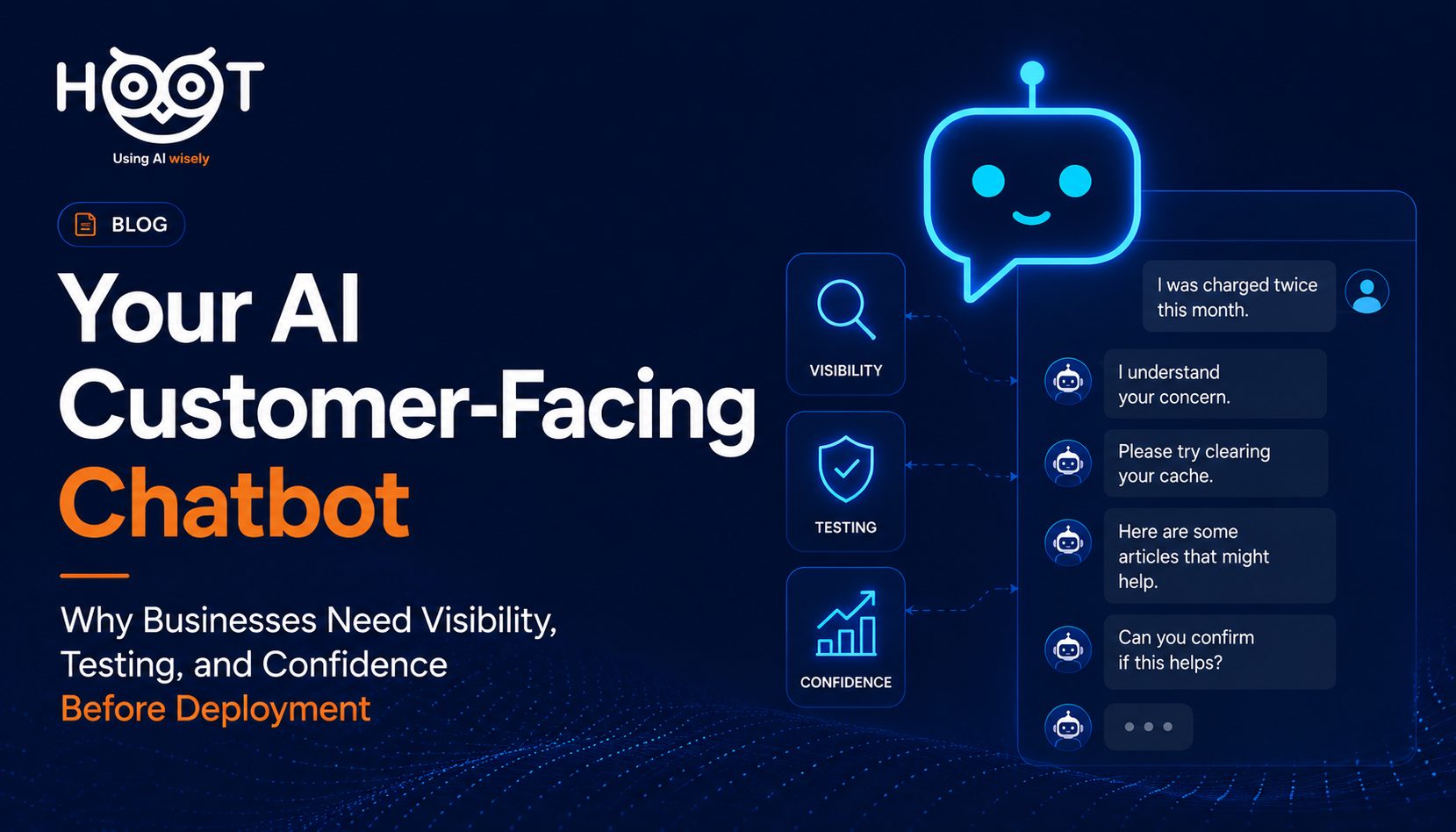
Why Businesses Need Visibility, Testing, and Confidence Before Deployment
Most businesses no longer ask if they should use AI.
The real question now is:
Can you trust the AI experience your customers are already seeing?
From banking and insurance to healthcare, utilities, and e-commerce, AI chatbots are quickly becoming the first line of customer interaction. They answer questions, guide decisions, explain policies, and shape customer experience in real time.
But there is a growing issue many companies are only starting to notice:
AI systems can behave inconsistently, and most failures happen silently.
AI Is Now Customer-Facing
Today’s AI chatbots are no longer internal experiments.
They are already:
- answering customer support questions
- handling sensitive information
- explaining products and policies
- assisting users across websites and apps
- representing the company’s brand and tone
For many businesses, the chatbot has quietly become a digital frontliner.
The challenge is that AI does not behave like traditional software.
Unlike static systems, AI responses can vary depending on wording, context, prompts, model updates, integrations, or even conversation history.
That means the same customer question may not always produce the same answer.
The Hidden Risks Businesses Are Overlooking
Many AI deployments appear to work well during demos or early testing.
But once exposed to real customer conversations, issues begin to surface:
Inconsistent Responses
Two customers asking similar questions may receive completely different answers.
Incorrect or Misleading Information
AI can confidently generate responses that sound correct, even when they are inaccurate.
Tone and Brand Misalignment
Responses may drift away from the company’s intended tone, professionalism, or compliance standards.
Regression After Updates
A chatbot that worked properly last week may behave differently after model or prompt changes.
Lack of Visibility
Most businesses still do not have a clear way to monitor, validate, or test AI behavior before deployment.
These issues are especially critical in regulated and customer-sensitive industries where trust matters most.
AI Failures Are Often Silent
One of the biggest misconceptions about AI risk is that failures are always obvious.
In reality, most AI problems do not look dramatic.
They often appear as:
- different answers across channels
- customer confusion that never gets reported
The AI may still appear “functional,” while quietly creating risk underneath.
That is what makes AI governance and testing different from traditional software QA.
Testing AI Is No Longer Optional
As AI becomes customer-facing, businesses need more than basic chatbot deployment.
They need:
- visibility into AI behavior
- consistency across interactions
- monitoring after deployment
- governance for continuous updates
AI systems are dynamic.
Without testing and validation, businesses are essentially deploying unpredictable customer experiences at scale.
Where Hoot Fits
Hoot helps businesses gain confidence in their AI systems before and after deployment.
By testing conversational AI behavior, validating responses, and identifying inconsistencies early, teams can reduce risk while improving customer trust and experience.
As AI adoption continues to grow, businesses that prioritize AI visibility, governance, and testing will be better prepared to scale responsibly.
Because once AI becomes customer-facing, every response matters.
Why Businesses Need Visibility, Testing, and Confidence Before Deployment
Most businesses no longer ask if they should use AI.
The real question now is:
Can you trust the AI experience your customers are already seeing?
From banking and insurance to healthcare, utilities, and e-commerce, AI chatbots are quickly becoming the first line of customer interaction. They answer questions, guide decisions, explain policies, and shape customer experience in real time.
But there is a growing issue many companies are only starting to notice:
AI systems can behave inconsistently, and most failures happen silently.
AI Is Now Customer-Facing
Today’s AI chatbots are no longer internal experiments.
They are already:
- answering customer support questions
- handling sensitive information
- explaining products and policies
- assisting users across websites and apps
- representing the company’s brand and tone
For many businesses, the chatbot has quietly become a digital frontliner.
The challenge is that AI does not behave like traditional software.
Unlike static systems, AI responses can vary depending on wording, context, prompts, model updates, integrations, or even conversation history.
That means the same customer question may not always produce the same answer.
The Hidden Risks Businesses Are Overlooking
Many AI deployments appear to work well during demos or early testing.
But once exposed to real customer conversations, issues begin to surface:
Inconsistent Responses
Two customers asking similar questions may receive completely different answers.
Incorrect or Misleading Information
AI can confidently generate responses that sound correct, even when they are inaccurate.
Tone and Brand Misalignment
Responses may drift away from the company’s intended tone, professionalism, or compliance standards.
Regression After Updates
A chatbot that worked properly last week may behave differently after model or prompt changes.
Lack of Visibility
Most businesses still do not have a clear way to monitor, validate, or test AI behavior before deployment.
These issues are especially critical in regulated and customer-sensitive industries where trust matters most.
AI Failures Are Often Silent
One of the biggest misconceptions about AI risk is that failures are always obvious.
In reality, most AI problems do not look dramatic.
They often appear as:
- different answers across channels
- customer confusion that never gets reported
The AI may still appear “functional,” while quietly creating risk underneath.
That is what makes AI governance and testing different from traditional software QA.
Testing AI Is No Longer Optional
As AI becomes customer-facing, businesses need more than basic chatbot deployment.
They need:
- visibility into AI behavior
- consistency across interactions
- monitoring after deployment
- governance for continuous updates
AI systems are dynamic.
Without testing and validation, businesses are essentially deploying unpredictable customer experiences at scale.
Where Hoot Fits
Hoot helps businesses gain confidence in their AI systems before and after deployment.
By testing conversational AI behavior, validating responses, and identifying inconsistencies early, teams can reduce risk while improving customer trust and experience.
As AI adoption continues to grow, businesses that prioritize AI visibility, governance, and testing will be better prepared to scale responsibly.
Because once AI becomes customer-facing, every response matters.