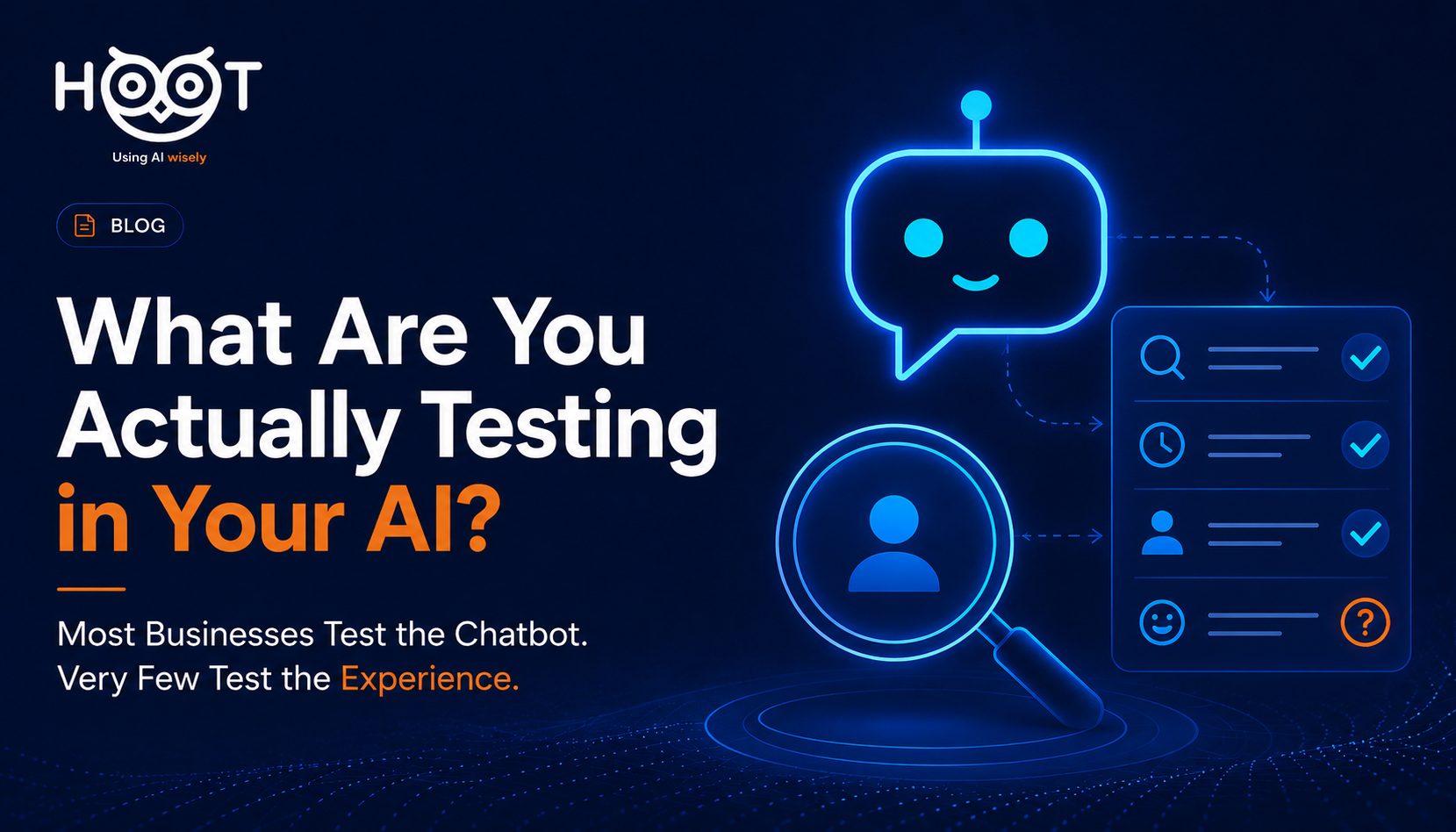
Most Businesses Test the Chatbot. Very Few Test the Experience.
As AI adoption continues to grow, more businesses are launching customer-facing chatbots, AI assistants, and automated support systems faster than ever before.
But there is one important question many teams still struggle to answer:
What exactly are you testing in your AI?
For many organizations, “testing the chatbot” simply means checking if it responds.
The chatbot answers questions.
The system runs.
The demo works.
But AI systems are far more complex than traditional software, and basic functionality alone is not enough.
Because in production environments, the real risks often come from behavior, consistency, and reliability over time.
AI Testing Is Different From Traditional QA
Traditional software is predictable.
If a button is programmed to do something specific, it should behave the same way every time.
AI does not work that way.
AI systems are probabilistic, meaning responses can vary depending on:
This means the same customer question may produce different answers across interactions.
That is why AI testing requires a completely different mindset approach.
Accuracy Is Only One Part of the Problem
Most teams focus heavily on whether the AI answer is “correct.”
But accuracy alone does not guarantee a safe or reliable customer experience.
Businesses should also be testing for:
Consistency
Does the AI provide stable answers across similar questions and scenarios?
Tone and Brand Alignment
Does the chatbot sound professional, trustworthy, and aligned with the company’s communication standards?
Compliance and Risk
Could the AI generate misleading, sensitive, or non-compliant information?
Regression After Updates
Did recent prompt changes, integrations, or model updates introduce new issues?
Context Handling
Does the AI maintain clarity and logic throughout longer conversations?
Multi-Channel Behavior
Does the AI behave consistently across web chat, mobile, support portals, and other platforms?
These are the areas where many hidden AI failures begin.
The Most Dangerous AI Problems Are Often Subtle
Many businesses expect AI failures to be obvious.
But in reality, the most damaging issues are often difficult to detect.
A chatbot may:
- sound confident while giving incomplete information
- slightly change explanations between customers
- misunderstand intent in edge cases
- drift away from approved messaging
- provide inconsistent policy explanations
- create confusion without triggering alerts
The AI may still appear functional on the surface while quietly creating risk underneath.
That is why visibility and monitoring matter just as much as deployment itself.
AI Confidence Requires More Than Deployment
Launching an AI chatbot is only the beginning.
As AI systems become more customer-facing, businesses need structured ways to:
- test conversational behavior
- monitor changes over time
Without proper testing, businesses are often operating AI systems they do not fully understand.
Where Hoot Fits
Hoot helps businesses test, validate, and gain visibility into conversational AI systems before and after deployment.
By helping teams monitor AI behavior, detect inconsistencies, and improve response confidence, Hoot supports safer and more reliable AI experiences across customer interactions.
Because the real question is : Do you truly know how your AI behaves?