
The EU Is Changing the Rules of AI. Independent Assurance Is Becoming Hard to Treat as Optional.

For the past few years, many organisations have approached AI governance largely as a matter of trust.
The AI vendor builds the system.
The vendor tests it.
The vendor publishes its performance metrics.
And the customer decides whether those assurances are sufficient to put the technology in front of employees, customers or critical business processes.
Europe is beginning to change that equation.
The EU AI Act is moving AI from a largely voluntary governance environment toward one where organisations increasingly need to be able to demonstrate what their AI does, how it has been tested, what risks have been identified and what controls are in place.
And importantly, this is no longer theoretical.
The AI Act entered into force in August 2024 and has been applying progressively. Prohibited AI practices and AI-literacy obligations began applying in February 2025. Obligations for providers of general-purpose AI models followed in August 2025.
And from 2 August 2026, another major stage arrived: transparency requirements became applicable and enforcement began for several parts of the regime.
The heavier requirements for many high-risk AI systems have been moved later under the EU’s Digital Omnibus changes, with Annex III high-risk requirements now scheduled for December 2027 and certain AI embedded within regulated products following in August 2028.
But delaying part of the timetable should not be confused with abandoning the direction of regulation.
The direction is becoming very clear:
If AI matters to the business, organisations increasingly need evidence that it works as intended.
From “Trust Us” to “Show Us”
This may ultimately be one of the most significant changes introduced by AI regulation.
For years, an AI provider could effectively say:
“We tested the system. Here are our results.”
Increasingly, that won’t be enough for organisations trying to demonstrate effective AI governance.
For high-risk AI, the EU framework establishes requirements around areas including risk management, data governance, technical documentation, record keeping, transparency, human oversight, accuracy, robustness and cybersecurity.
This creates a very different question for organisations deploying AI.
It is no longer simply:
“Do we believe this AI works?”
It increasingly becomes:
“Can we demonstrate that it works?”
Those are very different standards.
And That’s Where Independent Assurance Becomes Important
It is worth being precise here.
The EU AI Act does not require every AI system to be independently tested by an external organisation.
Some high-risk AI systems can follow an internal conformity-assessment process.
Others require the involvement of an independent notified body under specified circumstances. EU rules explicitly require those notified bodies to be independent of the provider whose system they are assessing.
But regulatory minimums aren’t necessarily the same thing as good enterprise governance.
Consider the position of a bank, insurer, healthcare provider, law firm or government organisation deploying AI.
If something goes wrong and a regulator, customer, board member, insurer or court subsequently asks:
“What evidence did you have that this system was safe and performing correctly?”
Would you want the answer to be:
“The company that sold it to us said it was.”
Probably not.
AI Vendors Should Test Their AI. But Customers Need Their Own Evidence.
There is nothing inherently wrong with AI vendors testing their own technology.
They absolutely should.
But vendor testing and customer assurance solve different problems.
The vendor wants to establish that its product performs according to its specifications.
The organisation deploying the AI needs to establish something much broader:
Does this AI perform correctly in our environment, against our data, policies, regulatory obligations and risk appetite?
Those aren’t necessarily the same tests.
An AI model could perform extremely well on a vendor’s benchmark and still perform poorly when confronted with the terminology, documents, customers or compliance requirements of a particular organisation.
Which is why independent testing becomes increasingly valuable.
Regulation Is Turning AI Performance Into Evidence
This is the bigger change organisations should be paying attention to.
AI governance is moving from policies and principles toward evidence.
Can you show what was tested?
Can you reproduce the tests?
Can you identify which model and version produced a particular result?
Can you demonstrate how accuracy was measured?
Can you identify hallucinations?
Can you prove compliance requirements were tested?
Can you show whether performance deteriorated following an update?
Can you demonstrate that known risks were identified and mitigated?
And can you produce that evidence months—or potentially years—later if something goes wrong?
That starts to look much less like traditional software testing.
It starts to look like AI assurance.
The AI Black Box Is Becoming a Business Requirement
Think about aviation.
A black box doesn’t prevent an aircraft incident.
It provides an objective record of what happened so investigators can determine what went wrong, whether procedures were followed and what needs to change.
Enterprise AI increasingly needs something similar.
Organisations need an independent evidence layer recording how AI systems were tested, how they performed, what changed and whether those changes affected their behaviour.
That evidence becomes valuable not only for regulators.
It potentially matters to:
Boards. Auditors. Insurers. Risk teams. Compliance teams. Customers. Lawyers. And eventually courts.
The value of AI assurance therefore extends far beyond simply “passing” an EU AI Act assessment.
It becomes part of demonstrating that the organisation exercised reasonable care when deploying AI.
Continuous Assurance Matters Even More
There is another problem with traditional certification.
AI changes.
Models are updated.
Prompts change.
Knowledge bases change.
Guardrails change.
Underlying LLMs change.
Applications integrating those models change.
And agentic AI can introduce entirely new workflows and behaviours.
A system that passed testing six months ago isn’t necessarily the same system operating today.
The EU framework recognises this problem. High-risk systems that undergo substantial modification can require a new conformity assessment.
That introduces an important principle:
AI assurance cannot simply be a one-off event.
Organisations increasingly need continuous regression testing and monitoring so they can understand whether an update has changed accuracy, compliance, reliability, safety or cost.
This Is Where Platforms Like Hoot Fit
This emerging environment creates a new layer in the enterprise AI architecture.
AI vendors provide the models, assistants and agents.
Organisations deploy them.
Platforms such as Hoot can provide an independent assurance layer between the two.
Rather than relying exclusively on the AI vendor’s own testing, organisations can continuously test their AI systems against their own requirements and create an auditable record of performance.
That can include testing for:
- accuracy and hallucination;
- reliability and regression;
- regulatory and policy compliance;
- safety and guardrails;
- model-to-model performance;
- document accuracy and comparison;
- performance drift;
- and cost versus performance.
The result isn’t simply another AI dashboard.
It is an independent body of evidence showing how an organisation’s AI actually performed.
The Question Has Changed
For the first phase of enterprise AI adoption, executives understandably asked:
“What can AI do for us?”
The next question was:
“How quickly can we deploy it?”
Regulation is introducing a third question:
“Can we prove that it works safely, reliably and compliantly?”
That question will become increasingly difficult to answer using the AI vendor’s own metrics alone.
The EU AI Act may not mandate independent assurance for every AI deployment.
But it is creating an environment in which organisations increasingly need objective, repeatable and auditable evidence about the AI systems they operate.
And as AI moves deeper into banking, insurance, healthcare, legal services, government and other regulated industries, independent assurance may increasingly become something organisations choose to implement before a regulator, insurer, auditor or customer asks them why they didn’t.
AI vendors will continue building the AI.
But organisations deploying it will increasingly need independent evidence that it can be trusted.
Latest Blogs
The latest news, strategies, and insights from Hoot.
AI Testing Is Not AI Assurance: Why the Difference Matters
Testing can show whether an AI system worked during a particular test. Assurance helps an organisation demonstrate how t...
Your AI Vendor Made the Mistake. The SRA Says You May Still Be Responsible.
Law firms are rapidly adopting AI. From legal research and document review to drafting, case management and client-facin...

AI Platform Vendors Build AI. They Don’t Independently Assure It
One of the biggest misconceptions in enterprise AI is that the organisation building the AI should also be responsible f...
What AI Insurance Reveals About the Future of AI Risk
When one of the world’s largest insurance groups launches dedicated AI liability insurance, it sends a powerful me...
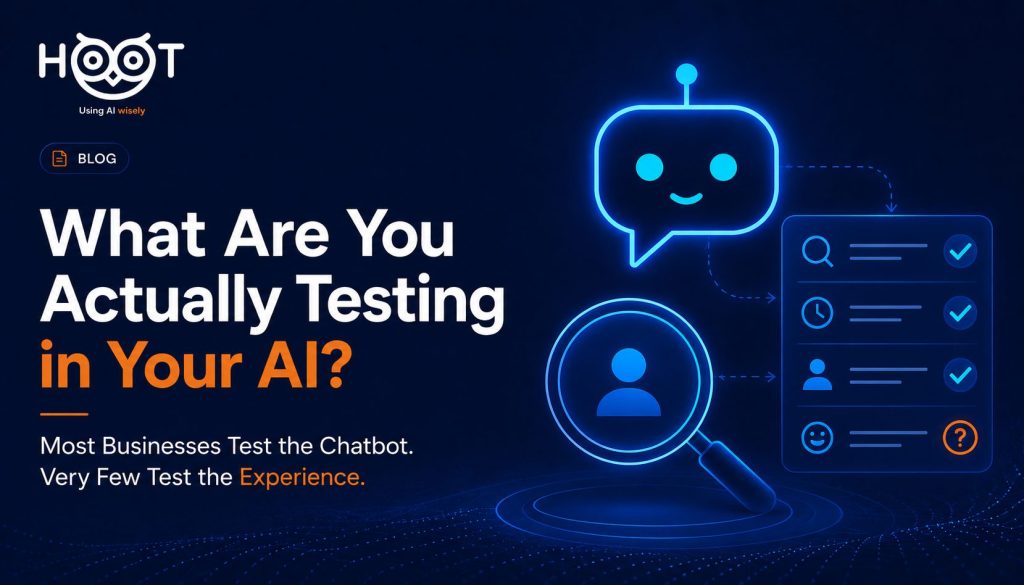
What Are You Actually Testing in Your AI?
Most Businesses Test the Chatbot. Very Few Test the Experience.

Your AI Customer-Facing Chatbot
From banking and insurance to healthcare, utilities, and e-commerce, AI chatbots are quickly becoming the first line of ...