
Deterministic vs Probabilistic Behavior
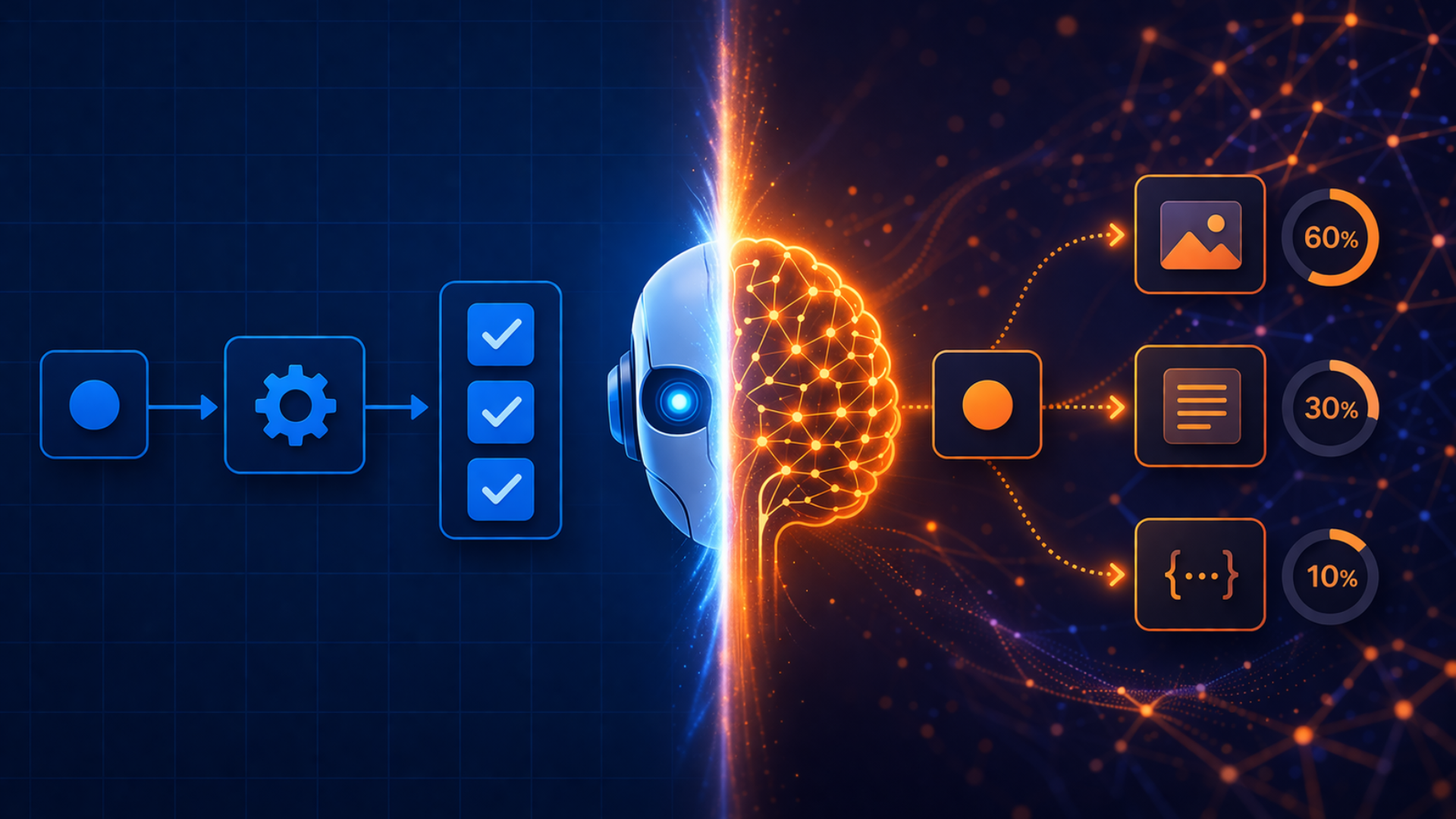
Why Traditional Software Testing Breaks Down for AI Systems
For years, most engineering teams have had a reliable mental model for quality. You build a feature, you define what “correct” means, you write test cases, and you check that the software behaves the same way every time. When something changes, your regression suite catches it. When something breaks, you reproduce it. That’s how modern software teams have shipped reliable products at scale.
Then AI entered the picture, and a lot of those assumptions started to wobble.
If you are building systems powered by large language models (LLMs), retrieval augmented generation, or agentic workflows that plan and act across tools, you are no longer testing a purely deterministic machine. You are testing a system that produces outputs based on probabilities, context, and learned patterns. Sometimes you get the same answer twice. Often you do not. And even when the answer changes, it might still be acceptable, helpful, and correct for the user.
That difference is not a small technical detail. It is a fundamental shift in how quality needs to be defined, measured, and managed. Traditional QA was designed for software where the correct answer is clear and repeatable. AI systems frequently live in a world where quality is a spectrum, risk is contextual, and correctness is not always a single fixed output.
This blog breaks down what that means in practice, why traditional testing breaks down for AI, and what teams should do instead when they want to ship trustworthy AI in production.
What deterministic software looks like and why it was easy to test
Deterministic software is the kind most of us grew up building. A deterministic system behaves predictably. If you give it the same input, it produces the same output, every time. The logic paths are explicit. The rules are usually inspectable. The business requirements can often be written as clear if-then statements. The system can be tested using fixed assertions like “this input should return that output,” and the testing framework can confidently treat deviation as failure.
This predictability is what made classic QA so powerful. You can write unit tests around individual functions. You can write integration tests around modules. You can run end to end tests across flows. You can build regression suites that protect you from accidental breakage. You can measure coverage and track the risk of change. And when the test fails, you can usually reproduce the failure and fix it.
Most importantly, deterministic software testing assumes a stable notion of correctness. The output is either right or wrong. The status is pass or fail. There is comfort in that binary model. It reduces debate, it speeds decision making, and it makes release gates straightforward.
That model works because the systems themselves are built on explicit logic and stable behavior.
How AI systems behave differently, and why variability is normal
AI systems, especially those powered by LLMs, are not deterministic in the same way. They generate outputs based on probability distributions over language, shaped by training data, fine tuning, system prompts, context, and runtime parameters. In simple terms, the model is not retrieving a single “correct” output from a rule set. It is generating a response that it believes is most likely to fit the prompt and context.
This means the same prompt can produce different outputs across runs, even when everything seems identical. Differences can come from temperature and sampling settings, minor changes in context ordering, hidden system instructions, model updates, or tool latency that changes the available context at the moment of generation. Agentic systems add even more variability because the model may choose different plans or tool calls depending on what it “sees” in the environment.
Here is the key mindset shift: variability is not automatically a defect. In many applications, multiple answers can be valid. A customer support assistant might explain the same policy in different wording. A marketing assistant might write multiple strong headlines for the same product. A coding assistant might solve a problem using different approaches. You are not always looking for one exact string. You are looking for an output that meets a standard.
So the question is no longer “did we get the exact expected output?” It becomes “did we get an output that is acceptable for the user and safe for the business?”
That sounds subtle, but it changes everything about QA.
Why traditional test cases fail for AI systems
Traditional software test cases assume a single expected result and stable reproducibility. You define inputs, define expected outputs, and compare. This is assertion based testing. It works beautifully for deterministic functions and APIs. It becomes fragile for AI outputs.
The first problem is that there is rarely one single correct output. Even when there is a factual answer, there are many ways to express it. If your test expects exact match, you will label correct outputs as failures. If you loosen the match too much, you will accidentally allow incorrect outputs through. Many teams start with “contains keyword” checks and quickly learn that those checks can be gamed by confident nonsense.
The second problem is reproducibility. In classic QA, “works on my machine” is an anti pattern. In AI, it becomes a default reality unless you design your evaluation process differently. If a failure only happens 3 percent of the time, it can still be catastrophic in production if you have enough volume. Traditional single run test cases will miss that.
The third problem is edge cases. In deterministic systems, you can reason about edge cases by inspecting logic branches. In AI systems, behavior is shaped by learned representations and complex context interactions. Edge cases often emerge from prompt ambiguity, unusual user phrasing, adversarial inputs, or rare combinations of context. You cannot enumerate them all using the same strategies you used for classic software.
Put simply, conventional QA was built for stable outputs and inspectable logic. AI gives you variable outputs and opaque reasoning. That mismatch causes many “green builds” to hide real risk.
The deterministic assumptions that no longer hold
Let’s name the assumptions that quietly sit under traditional testing:
Repeatability: The system behaves the same given the same input.
Inspectable logic: You can trace why the system did what it did.
Binary correctness: The output is either correct or incorrect.
Stable requirements: The target behavior is fixed and explicit.
AI systems weaken all of these.
Repeatability is not guaranteed because generation is probabilistic and context dependent. Inspectable logic is limited because the model’s internal reasoning is not a readable decision tree. Binary correctness often collapses into a spectrum, because “helpful but incomplete” is not the same as “unsafe,” and “slightly off tone” is not the same as “factually wrong.” Requirements can also evolve faster because prompt changes, model upgrades, retrieval changes, and tool integrations can all shift behavior without changing the surrounding application code.
This is why teams feel like traditional QA gives them false comfort. The tests pass, but users still encounter failures that matter.
The shift from correctness to confidence
In production AI, the goal is rarely “it is always perfect.” The goal is confidence that the system stays within acceptable bounds.
Confidence looks like this: the assistant is accurate enough for the use case, safe enough for real users, consistent enough to trust, and aligned with your policies and brand voice. It refuses when it should. It does not hallucinate critical facts. It does not leak sensitive data. It does not produce harmful content. It is robust across the real-world ways users actually ask questions.
That is not a single assertion. That is a set of probabilistic guarantees.
So instead of asking “is it correct,” you start asking “how often is it acceptable,” “under what conditions does it fail,” and “how bad are the failures when they happen.”
That is a more mature way to think about quality, especially when the system is generating language that has business and user trust implications.
Probabilistic systems require probabilistic testing
If the system’s behavior is probabilistic, your testing must be probabilistic too. That means you need to evaluate performance across repeated runs and diverse scenarios, then measure outcomes statistically instead of treating one run as truth.
A practical approach often includes:
Multi run evaluation: Run the same prompt multiple times and measure variance. If the model is unstable, you want to know. If it is stable, you can quantify that stability.
Scenario based test sets: Build test suites around real user intents and risk categories. Include common tasks, tricky phrasing, and known failure modes. Keep these sets versioned and evolving.
Threshold based gates: Instead of one pass or fail, set acceptance criteria like “at least 95 percent of responses meet safety requirements” and “at least 90 percent meet factual correctness for the approved knowledge base.” The numbers depend on risk and domain.
Rubric scoring: Evaluate along dimensions that matter, such as factuality, completeness, clarity, tone, policy compliance, refusal quality, and grounding to sources. AI output quality is multidimensional. Your evaluation should be too.
Error taxonomy and severity: Classify failures by type and impact. A minor tone issue is not the same as a harmful medical claim. In AI, severity matters as much as frequency.
Drift monitoring: Treat production as part of the test system. Monitor for changes over time, especially after model updates, prompt revisions, retrieval changes, or tool integration changes.
This is not about making testing complicated for the sake of it. It is about matching the method to the nature of the system. If the output can vary, you must measure that variation and decide what level of variation is acceptable.
Why this matters in production, and what happens when you ignore it
When deterministic testing is applied to AI systems, one of two bad outcomes usually happens.
The first is false confidence. You create a test that passes in your staging environment, and you ship. Then real users prompt the system in ways your test never covered. The assistant hallucinates, misunderstands, or confidently responds with unsafe advice. Trust erodes quickly, and once trust is lost, it is expensive to regain.
The second is over constraint. You try to force AI into deterministic behavior by making tests overly strict, reducing creativity, or locking outputs into templates. That can work for narrow tasks, but it often destroys the value that made AI useful in the first place. You end up with an assistant that is safe but unhelpful, which is another way to fail in production.
The middle path is better: accept that AI is probabilistic, then design guardrails and evaluation that manage risk while preserving usefulness. That is how you scale AI responsibly.
And this matters because production AI systems are not just features. They are interfaces to your brand. They represent your policies. They shape customer experience. They can create legal exposure. They can influence user decisions. Quality is no longer only an engineering concern. It becomes a business risk and trust concern.
Conclusion: Testing strategies must evolve to match AI reality
AI systems are fundamentally different from traditional software systems. They do not always produce the same output for the same input, and that is not automatically a bug. It is how probabilistic generation works. But that variability demands a new approach to testing, one built around confidence, thresholds, risk, and statistical measurement rather than exact string matching.
If your team is moving AI from experiment to production, the main question to ask is simple: are you testing for deterministic correctness, or are you building confidence that the system behaves safely and usefully under real-world conditions?
That shift in mindset is the difference between shipping AI that looks good in a demo and shipping AI that earns trust at scale.
Latest Blogs
The latest news, strategies, and insights from Hoot.
AI Testing Is Not AI Assurance: Why the Difference Matters
Testing can show whether an AI system worked during a particular test. Assurance helps an organisation demonstrate how t...

Your AI Vendor Made the Mistake. The SRA Says You May Still Be Responsible.
Law firms are rapidly adopting AI. From legal research and document review to drafting, case management and client-facin...
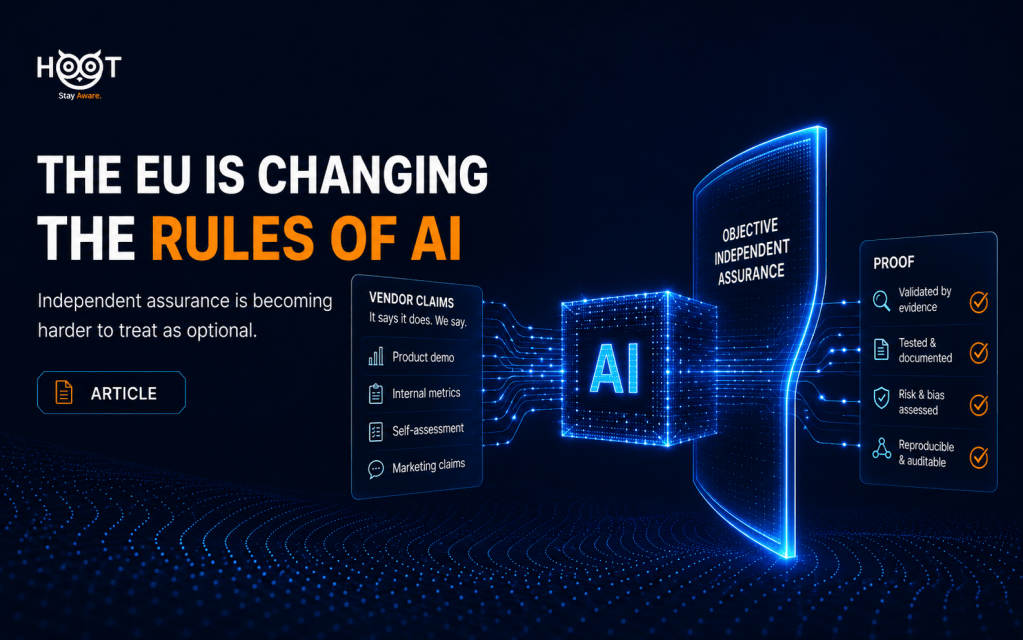
The EU Is Changing the Rules of AI. Independent Assurance Is Becoming Hard to Treat as Optional.
For the past few years, many organisations have approached AI governance largely as a matter of trust.

AI Platform Vendors Build AI. They Don’t Independently Assure It
One of the biggest misconceptions in enterprise AI is that the organisation building the AI should also be responsible f...
What AI Insurance Reveals About the Future of AI Risk
When one of the world’s largest insurance groups launches dedicated AI liability insurance, it sends a powerful me...
What Are You Actually Testing in Your AI?
Most Businesses Test the Chatbot. Very Few Test the Experience.